If you have ever looked at a cricket market and wondered what a number like 1.90 or 3.40 actually means, this guide is for you. Odds are simply a way of expressing how likely an outcome is judged to be, and how much a stake would return if that outcome happens. Understanding them is the difference between playing with your eyes open and guessing in the dark. This is a plain-English explainer written for adults aged 18 and above, and it deliberately avoids the two things no honest odds guide should ever contain: tips that "guarantee" a result, and invented numbers dressed up as certainty.
One honest note up front. Odds are an estimate of probability, not a prediction of what will happen. A short price does not mean an outcome is safe, and a long price does not mean it is impossible. Anyone selling "fixed" odds tips or a "sure" market is misleading you, and this guide will show you exactly why the numbers can never work that way.
What decimal odds actually mean
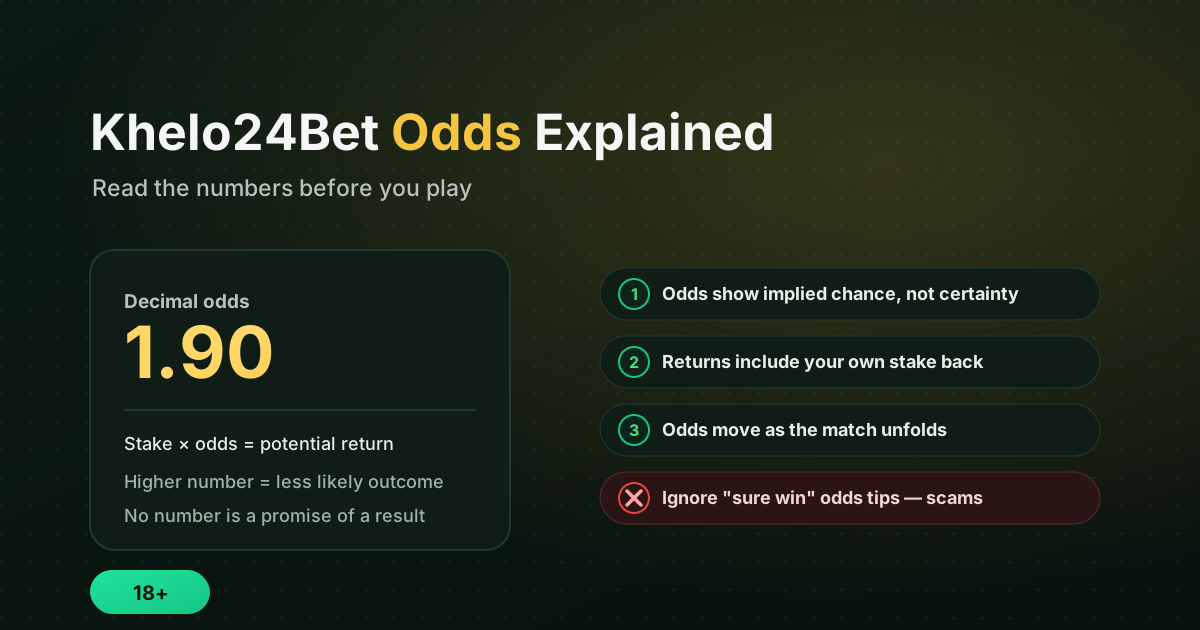
Most Indian users see decimal odds, which are the easiest format to read. The number represents the total you would get back for each unit staked, including your own stake. So at odds of 2.00, a winning bet returns two units for every one placed — your original stake plus the same amount again. At 1.50 you would get one and a half units back, and at 3.00 you would get three. The higher the number, the less likely the outcome is judged to be, and the more a winning stake would return relative to its size.
The quickest way to read any price is this: a number close to 1.00 signals a strongly favoured outcome with a small return, while a larger number signals an outcome seen as less likely with a bigger potential return for the same stake. Neither tells you what will happen — only what the market currently judges the balance of chance to be.
How a potential return is worked out
The arithmetic is simple, and doing it yourself before you commit is a good habit. Potential return is just your stake multiplied by the decimal odds. Your potential profit is that figure minus the stake you put in. The table shows how the same modest stake behaves at different prices — the amounts are only illustrations of the maths, not offers or predictions.
| Decimal odds | Return per 1 unit staked | What it signals |
|---|---|---|
| 1.50 | 1.50 back (0.50 profit) | Outcome judged fairly likely |
| 1.90 | 1.90 back (0.90 profit) | Roughly an even contest |
| 2.50 | 2.50 back (1.50 profit) | Outcome judged less likely |
| 4.00 | 4.00 back (3.00 profit) | Outcome judged unlikely |
Notice the trade-off built into every row: the bigger the potential return, the lower the judged chance of it landing. That balance is the whole point of odds, and no market escapes it. If you are still setting up and have not yet placed anything, the cricket access guide explains how the cricket side works once your Khelo24Bet ID is ready.
Turning odds into a chance figure
You can flip any decimal price into a rough percentage chance by dividing 1 by the odds. So 2.00 implies about a 50% chance, 1.50 implies about 67%, and 4.00 implies about 25%. This "implied probability" is useful because it turns an abstract number into something intuitive: at 4.00, the market is effectively saying this happens roughly one time in four. If your own honest read of a match disagrees with that, you at least understand what you are weighing up — rather than staking on a number with no idea what it represents.
Add up the implied percentages across all outcomes in a market and you will find they come to a little more than 100%. That small extra is the operator's built-in margin, and it is the reason the odds are never a perfectly fair coin. It is also the clearest mathematical proof that, over time, the numbers are not tilted in the player's favour — which is exactly why treating any stake as entertainment rather than income is the only sensible approach.
Why odds move
Odds are not fixed. They shift before and during a match as new information arrives, and understanding why stops the movement from surprising you.
- The match situation changes. In live cricket, a wicket, a big over or a rain break can swing the judged balance quickly, and the numbers follow.
- Conditions and team news. The toss, the pitch, and a late change to a line-up all feed into how likely each outcome looks.
- Where the money is going. Markets adjust as interest builds on one side, which nudges prices in the other direction.
The practical takeaway is that a price you saw an hour ago may not be the price now, so always read the current number on the screen rather than one you remember. And because live odds can move fast, they are a place where calm discipline matters most.
The honest limits of odds
This is the part cheap "tipster" accounts never tell you. Odds describe probability; they do not remove risk. A heavily favoured team at a short price loses often enough that "short" and "safe" are not the same word. Sport is uncertain by nature — that unpredictability is the entire reason the markets exist — and no reading of the numbers changes it. If someone offers you "guaranteed" odds, a "fixed" match tip or a "no-risk" market, treat it as a scam signal, not a shortcut. Our guide on whether Khelo24Bet is safe covers how these tricks are dressed up, and the balanced Khelo24Bet review explains why no honest source publishes guaranteed outcomes.
A calm routine before you stake
Reading odds well is as much about temperament as arithmetic. Run through this short routine every time, and the numbers stay a tool rather than a trap.
- Read the current price, not a remembered one. Confirm the number on screen before you commit anything.
- Do the maths yourself. Stake times odds is your potential return; know it before, not after.
- Translate it to a chance. One divided by the odds tells you the implied percentage — does it match your own honest view?
- Set the stake from your budget first. Decide what you can comfortably lose, then look at odds — never the other way round.
- Never chase a move. A price swinging against you is not a reason to stake more to "win it back".
Keeping your account itself secure while you play is a separate but equally important habit; the guide to keeping your gaming ID safe covers it, and any doubt about a market or your account can go to the official support channel.
Common spelling note
Some users search for "khelo24ber odds" or "khelobet24 odds", where letters are transposed or the "t" is mistyped as "r". The correct brand spelling is Khelo24Bet. If a typo brought you here you are in the right place — but always double-check any site that shows you odds and asks for your details, because typo domains are a favourite way to run fake markets and phishing pages.
Play safely and responsibly
Understanding odds makes you a more informed player, but it never makes an outcome certain, and it never turns entertainment into income. Khelo24Bet is strictly for adults aged 18 and over, in regions where such play is permitted. Set a budget before you look at a single price, treat any money staked as the cost of entertainment, and never chase losses or borrow to play. If it ever stops feeling fun, step away and reach out to a professional support organisation. Read the numbers honestly, keep your stakes within your limits, and let the odds inform your choices rather than control them.